Field Trip Albert Village Lake
Field Outing Report from 4 February 2026 – Albert Village Lake, led by Peter Proudlove.
For some, this Club walk day dawned with a smattering of snow on the ground and a heavy looking mist in the sky, but 11 club members still met for out latest walk at a previously visited location.
As we awaited to be fully assembled, a flight of Greylag Geese headed for the lake, along with a lone Great Spotted Woodpecker seemingly rushing overhead. These feathered sightings were quickly added to by Woodpigeon and a very noisy Song Thrush with its long-repeated call, Robin and Blue Tit.
Some evidence of cutting back of footpaths was apparent throughout the site with plentiful Bramble, Gorse Ulex europaeus, (we were able to discount Western Gorse as the Bracteoles were longer than 1.5 mm), Hazel – with catkins attached, Rose – with blackened hips still attached, Beech, Oak and Alder also with catkins, Silver Birch and Blackthorn – still not completely picked clean of its fruits. Later various species of Willow (Salix) and a fallen branch of Ash, complete with its Bishop’s Mitre-shaped leaf buds went on the list.
It was not just the actual plants that attracted our attention, but other species finding homes amongst them. For example, the moth leaf miners Coptotriche marginea and Stigmella aurella on Bramble, the galls Marble, Artichoke and Ramshorn (all caused by wasps) on young oaks, and the tiny brown beetle Micrambe ulicis inside Gorse flowers.
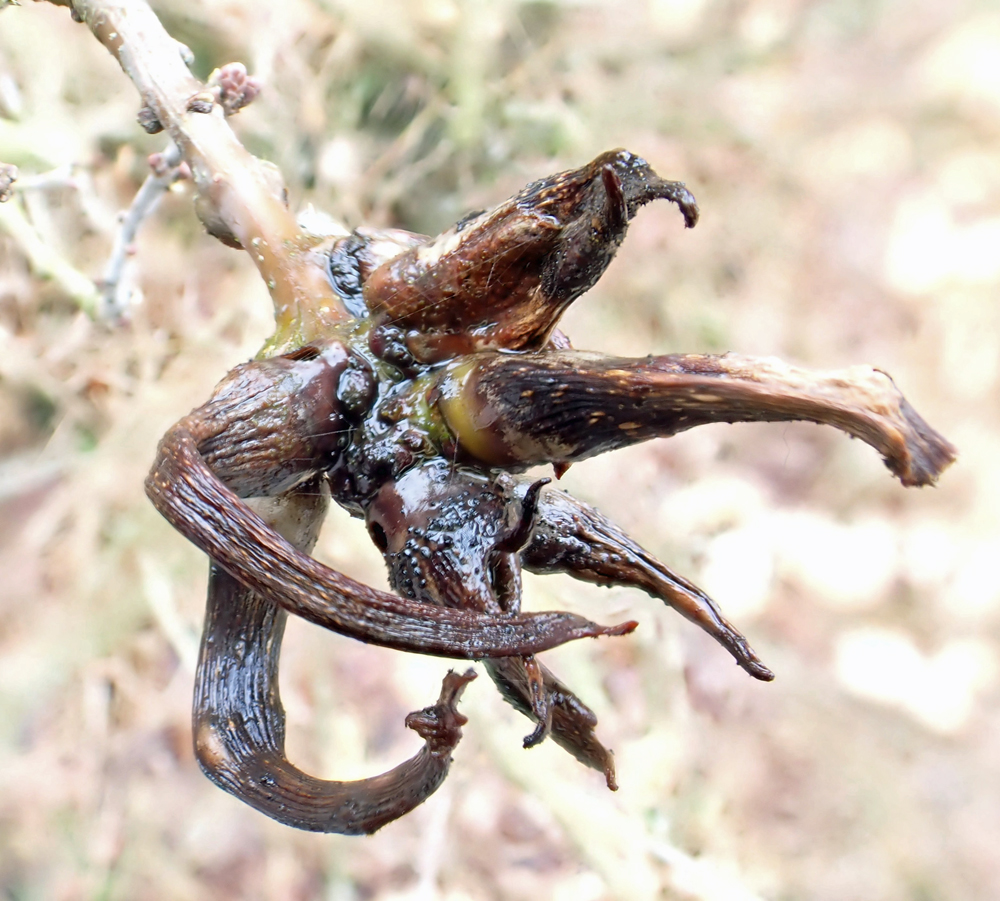
Also found was a Teasel Marble Moth Endothenia gentianaeana in its larval state inside a Teasel head. The hardened black centre of a Robin’s Pincushion gall on Dog Rose, which would produce a Wasp Diplolepis rosae or one of the many parasites or inquilines (lodgers) that live within the gall.
On the ground, there was evidence of last year’s Wild Carrot, and Red Bartsia, new shoots of Shining Cranesbill and Common Vetch. Grasses included Crested Dog’s-tail and Tufted Hair Grass Deschampsia cespitosa. Pendulous Sedge, Common Reed Phragmites australis, Hard Rush Juncus inflexus and Bulrush Typha latifolia were also present.
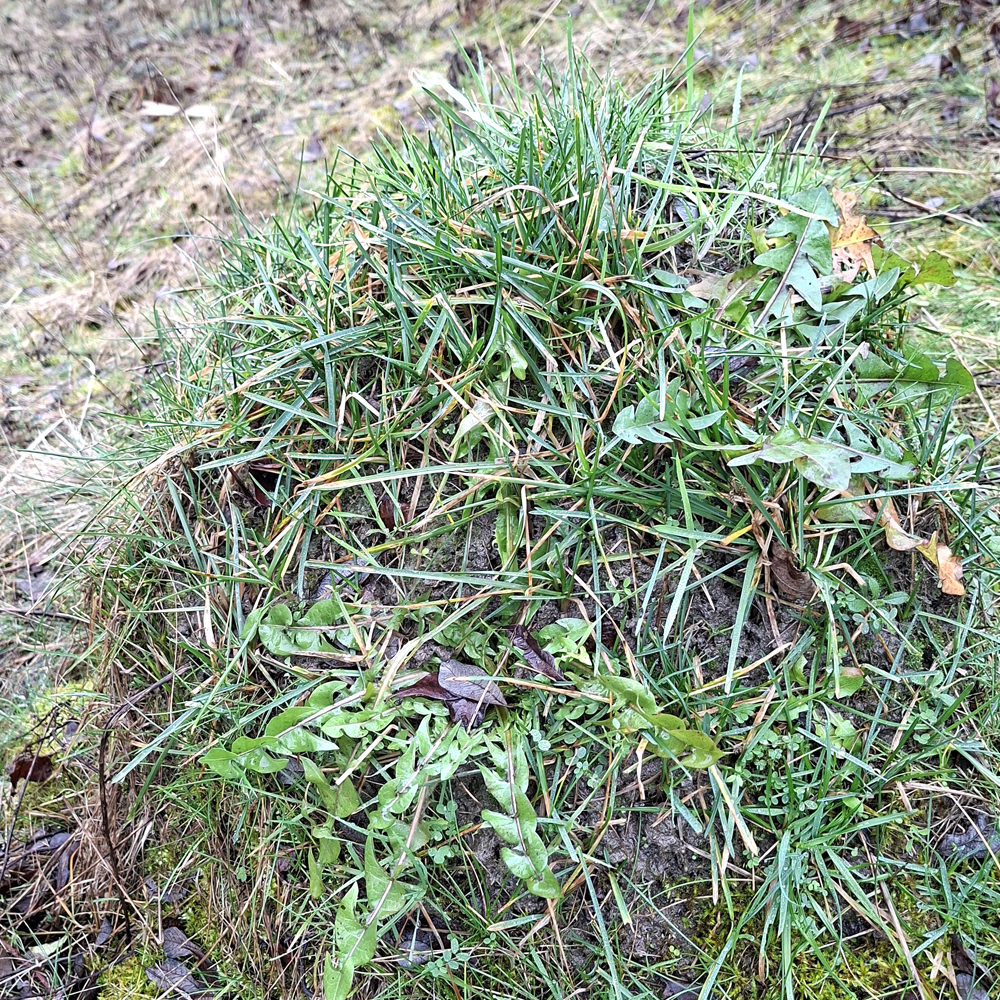
Terry was first to spot two meadow ant edifices presumed to be Yellow Meadow Ant -which seem to be host to a number of plants species not immediately apparent within the same space. Not fully investigated but apparently species from the Dandelion, Vetch and Clover family and one plant was identified as Common Mouse-ear Cerastium fontanum.
Not to be out-recorded by the stationary exhibits of the day, the lake played host to Mallard, Coot, Black–headed Gull, Mute Swan, Cormorant, Great Crested Grebe, Tufted Duck and a single Moorhen, and more unusually for this site, two Pochard along with an Egyptian Goose. Hiding deep with the reeds was the unmistakable call of a Little Grebe, and the less well-known pig-like squeal of a Water Rail.
On the land side of the lake the more usual array of Blackbird, Robin, Great Tit, Chaffinch, Dunnock and Goldfinch, were joined by the less often seen Goldcrest, Bullfinch, Greenfinch, Green Woodpecker and Stock Dove.
The UK plays host to eight members of the Corvid family, on display today were four, Magpie, Jackdaw, Jay and Carrion Crow.
As ever, Hazel (not the plant) could be found rustling in and under many bushes. On her previous site visit she had taken photos of galls on the new shoots of cut Willow alongside the path but had discovered that the galls need to be opened, and the pale orange larvae examined for identification. Sue Timms had previously found the gall of the midge Rabdophaga salicis at this site. Where there were plentiful galls on the stems, a short section containing three galls was removed to examine under the microscope. There had been evidence of inhabitation of the bumps on the stem, as the tissue was brown and decaying, but no larvae were found so no identification possible. The larvae pupate inside the galls and emerge in spring so if these galls were due to Rabdophaga salicis they must have been from spring 2024. A visit in early autumn is called for.
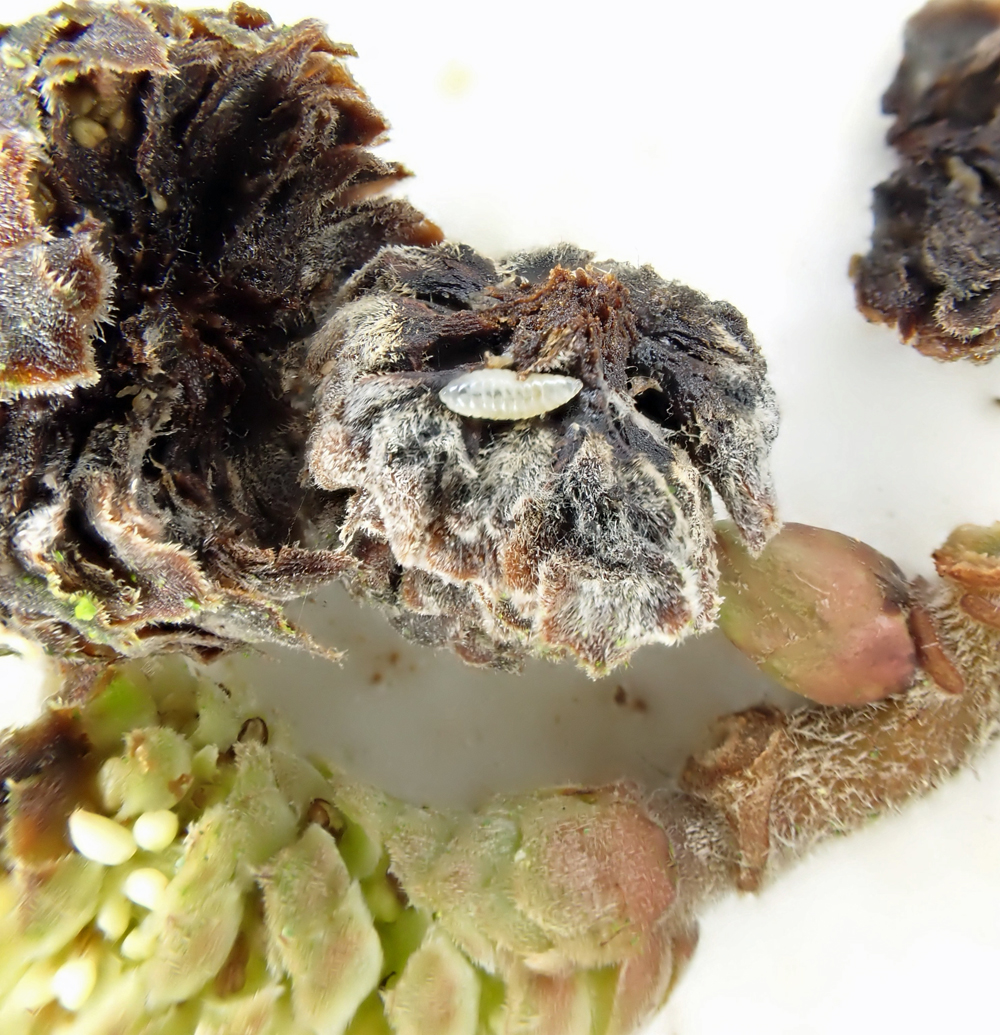
Hazel has also developed a habit this winter of examining Hazel catkins having realised that two gall causers disfigure catkins in similar ways and the catkins must be examined to find the causer. The gall caused by the mite Phyllocoptruta coryli has only been found once this winter, but mites are so tiny, virtually impossible to see and even more difficult to photograph. They are probably all hunkered down now in bark crevices to sit out the winter. However, the gall caused by the midge Contarinia coryli is being found every time a few distorted catkins are taken home, and this was the case at Albert Village Lake. A collection of about ten catkins yielded three larvae. One assumes that the larvae either pupate in the catkin and fall to the ground with it to overwinter or pupate in the ground after the catkin has fallen.
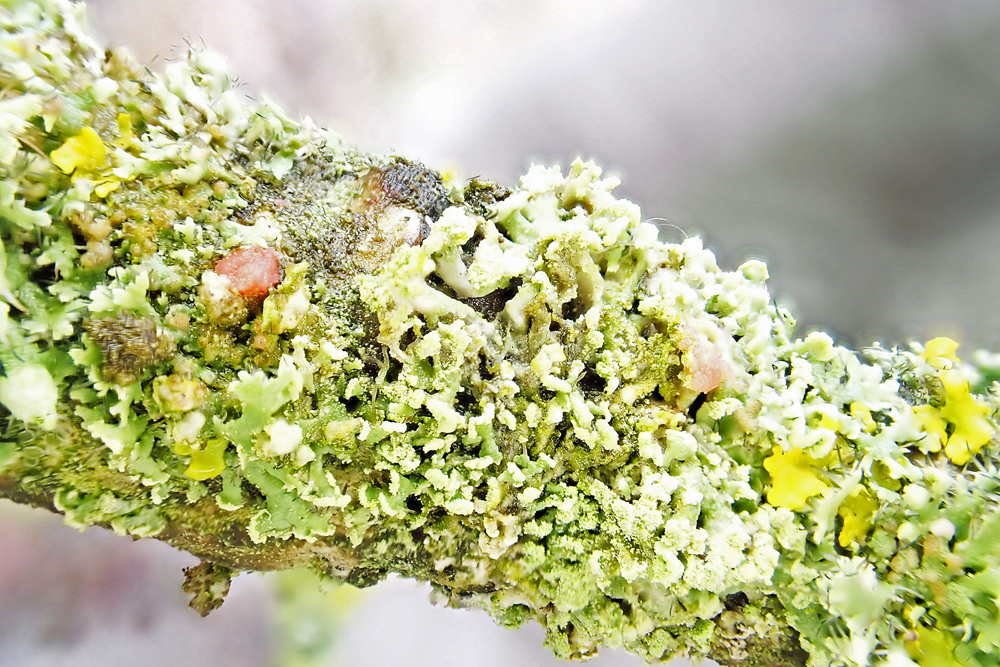
A few lichens were noted. The nitrophiles Xanthoria parietina, Physcia tenella and Physcia adscendens were greatly in evidence, plus occasional small patches of the pollution-resistant Hammered Shield Lichen Parmelia sulcata. Gray-green Disc Lichen Lecidella elaeochroma was found on immature birch saplings. Steve found the bubble-gum-pink lichenicolous fungus Illosporiopsis christiansenii growing on lichen on a twig. A small patch, almost hidden amongst the ground flora on the trackside, of a Cladonia species with beautiful cups was spotted, provisionally identified as Cladonia chlorophaea s.l. and now confirmed by Ivan Pedley.
Post visit, Steve alerted me to a piece of vegetation he had fished out of the water, Spiked Water-milfoil Myriophyllum spicatum. He also passed on that pretty much the whole area was confined to a single Monad SK3017 for your record keeping.
Margaret McLoughlin